





Did we just find the next Microstrategy?
Editor’s Note: Porter Stansberry is known for making bold predictions that cut against the mainstream, “approved” narrative.
He predicted the 1998 emerging market crisis, the 2007 financial crisis, the bankruptcy of General Motors, the loss of America’s AAA credit rating, and the current decline of the dollar.
Porter and his top performing analyst just went live with an urgent new broadcast that they say could be the most asymmetric opportunity of their careers. To get the full story, go here.
Or for more details, read Porter’s essay below.
Michael Saylor and I know each other.
I won’t go into the details here. It’s the kind of story I don’t want to leave a paper trail on. But if you’re at this year’s conference… pull me aside and I’ll share the full story face-to-face when I can maintain full deniability.
Anyway, Saylor’s name is everywhere nowadays.
But before 2020, I’d wager most people would’ve drawn a blank.
The pandemic forever changed that though.
With the world in turmoil, the CEO of MicroStrategy found himself in a rut.
His company’s stock hadn’t moved in years and it seemed devoid of any story that could propel it upward.
While the market valued MicroStrategy at $1.5 billion, it was a far cry from the tens of billions the company had been worth over two decades earlier during the dot-com bubble.
A time when Saylor’s personal stake alone had grown to almost $10 billion.
Now, Saylor was no stranger to taking entrepreneurial risk and the attendant cycle of boom and bust.
Just a few years after graduating from MIT where he studied aeronautics and science, Saylor had launched MicroStrategy in 1989 with a few friends.
The company initially focused on boring data-mining software. But as the internet bubble took off, Saylor deftly re-positioned MicroStrategy to benefit, buying up domain names such as hope.com and voice.com.
MicroStrategy stock soared, climbing to $313 per share in 2000, more than 30x its IPO price of $12.
The bursting of the dot-com bubble in 2000 hit MicroStrategy hard. But unlike thousands of other companies that filed for bankruptcy, the company survived.
Barely.
The stock slid all the way down to $0.45 per share, a 99.9% decline from its peak. A collapse that landed Saylor on the cover of the New York Daily News with the unenviable title of the man who “Lost $6 Billion In A Day.”
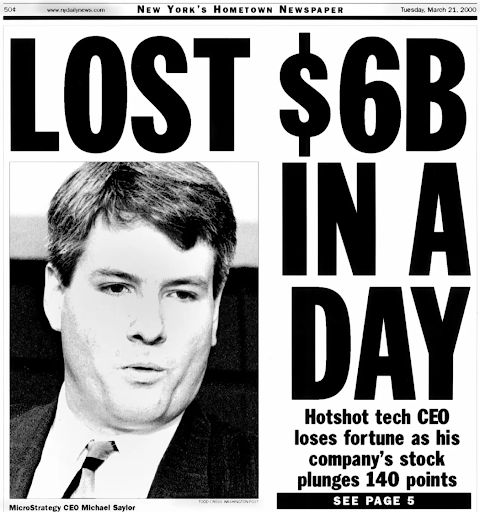
Still he did what needed to be done to survive, settling an inquiry by the SEC and undertaking a 10-for-1 reverse split on shares of MicroStrategy.
Over the ensuing decades, the company limped along.
Saylor was searching for the “next new thing,” a trend that he could ride as he had the growth of the internet.
He struggled to find one.
Aware of cryptocurrencies soon after their emergence, he initially dismissed Bitcoin in a 2013 Twitter post as a fad whose “days are numbered.”
But now in 2020, amid the thick of COVID, Saylor found himself re-thinking his views on Bitcoin.
A keen student of financial history, Saylor grasped that the federal government would print and spend trillions to reflate the economy after the pandemic.
These measures could well precipitate inflation.
The more he studied Bitcoin, the more he came to believe it could be one of the biggest beneficiaries of this reflationary spending.
More importantly, he came to believe in Bitcoin as the digital version of “sound money.” And so later in 2020, Saylor pitched MicroStrategy’s board on an audacious plan:
Take half of the company’s $500 million cash pile and invest it in Bitcoin.
The board agreed, and MicroStrategy made its first purchases of the cryptocurrency at a price of around $11,000 per coin.
Although Bitcoin dipped to $9,000 soon after, it finished 2020 above $26,000, more than double MicroStrategy’s initial cost basis.
That was all the vindication Saylor needed to invest with conviction.
With his board’s support, he began borrowing aggressively to increase MicroStrategy’s stake in Bitcoin, taking on billions in debt to accumulate the cryptocurrency.
Drawing on his decades’ experience at the helm of a public company, Saylor tapped into all the different ways MicroStrategy could raise fiat money to plough into continued Bitcoin purchases – bank loans, convertible debt, and even secondary sales of the company’s stock.
Last year alone – four years into its foray into Bitcoin – MicroStrategy raised a staggering $23.2 billion in combined debt and equity to fund its ongoing crypto purchases.
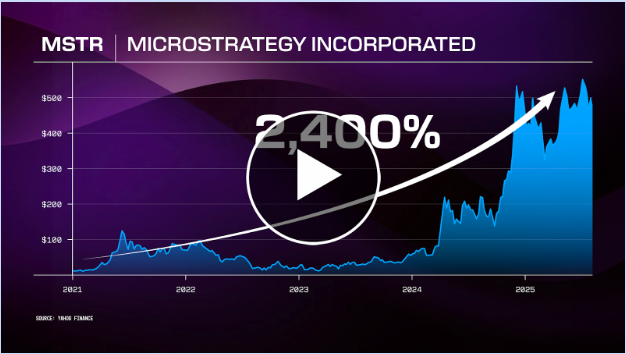
As Bitcoin’s price has risen, it now trades for around $115,000, MicroStrategy’s stock has experienced an even greater parabolic rise.
Today the company, renamed Strategy, has a market cap of $103 billion – and investors have seen returns of more than 2,400% in a little over 5 years.
It’s one of the greatest growth stories of recent years and one that almost nobody could have seen coming.
For anyone who has ridden the MicroStrategy gravy train, congratulations.
And for those who missed it, I believe you could have a rare second chance.
Erez Kalir and I just hosted an event to unveil what we believe could potentially be the next MicroStrategy.
We detailed a company that is as little-known as MicroStrategy was back in 2020… with the very real potential for similar upside.
Just as MicroStrategy had a “boring” business before it pivoted to investing in Bitcoin, so too does the stock we want to share with you.
In MicroStrategy’s case, the legacy business was software. For our target, it’s financial services. And the underlying business is far stronger.
What’s more, the CEO is the polar opposite of Saylor… you’re never going to see him on CNBC pumping his stock or making outlandish promises.
He’s like Buffett in that way. He would never tell you to go out and buy his stock, it would be anathema to his personality.
But make no mistake: this could be one of the most lucrative investments of the next decade – a rare, truly asymmetric opportunity.
And we shared the full story with you. Including why right now could be your last chance to get in before five looming catalysts converge to potentially send the stock rallying.
Watch it now by clicking play below.
Good investing.
Porter Stansberry